Energy
Battery systems
Storage design begins with the load, operating profile, and safe limits.
Characterize energy and power, round-trip efficiency, duty cycle, temperature, charging, isolation, protection, ventilation, and end-of-life. Coordinate batteries with solar generation, inverters, controls, emergency power, and the applicable fire and electrical requirements.
Understanding the electricity bill
kW demand charges and kWh energy charges
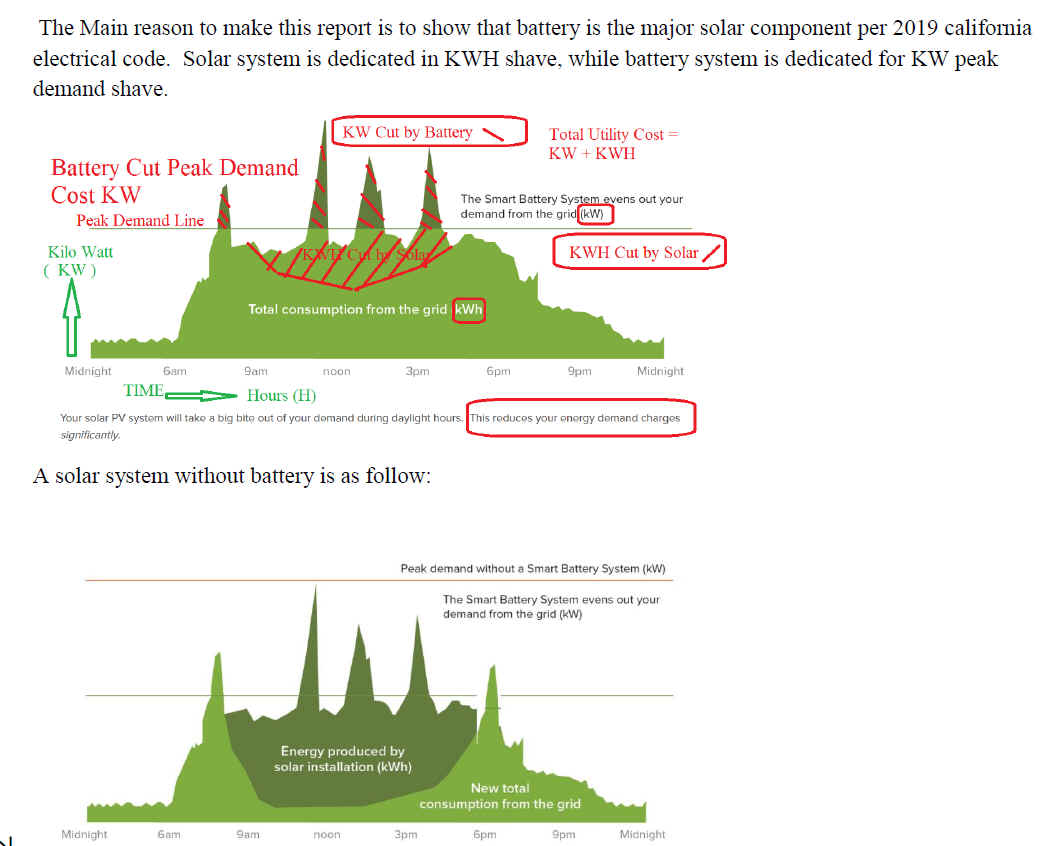
kW: how much power is needed at once
Demand charges apply a rate in dollars per kW to billing demand. This is commonly based on the highest average demand over a utility-defined interval, rather than a momentary spike. The tariff determines the interval, time periods, and any minimum or ratchet rules.
kWh: how much energy is used over time
A constant 10 kW load operating for 2 hours uses 20 kWh. Energy charges multiply billed kWh by the applicable dollars-per-kWh rate; time-of-use rates may vary by period.
A simple bill example
Illustrative rates only: 100 kW billing demand × $20/kW = $2,000; 20,000 kWh × $0.15/kWh = $3,000. Together these two components are $5,000, before fixed charges, taxes, adjustments, and credits.
The diagram's “kW + kWh” means demand charges plus energy charges. Power and energy quantities cannot themselves be added together. Not every rate plan has a separate demand charge.
SCE: energy and demand charge explanation
How solar and batteries can help
The curve's height represents power; the area under the curve represents energy. Solar can reduce purchased daytime energy and may reduce demand when generation coincides with the billing peak. A battery can discharge during high-demand intervals to reduce grid demand and shift energy use between periods.
Results depend on battery power (kW), usable capacity (kWh), controls, charging losses, and the tariff. Batteries do not generate energy; charging can create a new peak if poorly timed. Lower kWh alone does not guarantee lower demand charges.