Lesson · Digital systems
Digital logic and interface design.
A practical introduction to logic design tools, small-scale integrated circuits, and the systems they make possible.
From the original lesson
Start with the tools, then build the system.
The original lesson recommends a digital oscilloscope, a voltmeter, and a TTL databook for specification reference. Small-scale integrated circuits are introduced through lab practice.
Once the fundamentals are understood, the sequence moves through flip-flops, counters, adders, and bus-structure computer design. Applications include the IBM PC bus, programmable logic controllers, and system communication prototypes.
Digital systems textbook
The TTL Data Book for Design Engineers

Use this book to study TTL logic families, device specifications, pin functions, timing, and practical digital circuit design. Pair the historical reference with current component datasheets because part numbers, electrical limits, and availability change over time.
TTL training data
Function tables and flip-flop data
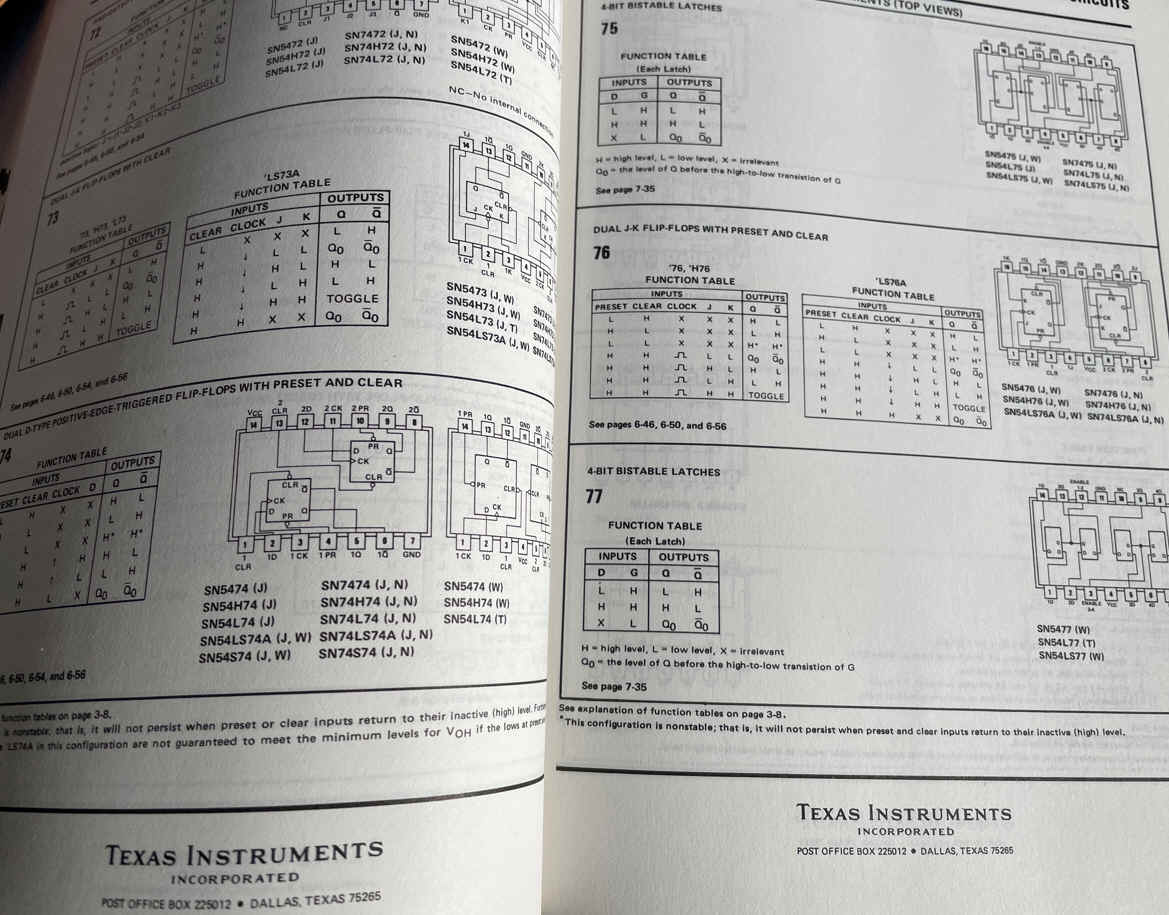
These pages show how to read TTL device data: function tables connect input states to outputs, logic symbols show pin relationships, and package diagrams identify pins for clock, preset, clear, power, and outputs.
The examples include bistable latches and dual J-K flip-flops, which are useful for studying memory elements, edge-triggered operation, preset and clear behavior, and toggle modes. Treat the page as a learning reference; always use the current manufacturer datasheet for a real circuit.